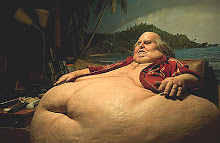
At a recent SFFA event I was shocked to hear that other countries are interested in buying land in Australia with the sole purpose of farming food to then export to their own country and people!
This would be because of sparse farming land available in the interested country. Not necessarily because of soil infertility or some other environmental reason, but because the land has been used for other purposes.
Perhaps it would be a good idea to use this example (and make Australians a little more land protective along the way) to create public awareness on current land use issues, and make an example out of this worst case scenario.
Who needs a McMansion (oversized family home in a showhome stepford style of suburb) when there are no people to live in it because there is no food to feed them!?
Wednesday, March 31, 2010

Wednesday, March 24, 2010
The Spot Food & Film Festival

After recently joining the Sydney Food Connect Team I was asked to man a stall at the recent Spot Food and Film Festival put on by Randwick Council in the first week of March.
The event was run down St Pauls Street in front of the Ritz and up the northern restaurant strip of Perouse Road. Our booth was situated right at the junction of the streets and involved a produce selling and cooking area as well as a small information board about Sydney Food Connect.
My job: to sell organic chemical and pesticide free gala apples - a steal at $2.50 per kilo - freshly picked from a farm in Orange, as well as informing the locals about SFC.
I must say it was interesting being in the eastern suburbs of sydney and seeing the difference in views about fresh quality produce. The majority of parents were more than happy to suffice their childs hunger/whining with a soft serve ice cream (whose truck was opposite our stand) than a fresh apple from us.
On the day we had 3 cooking demonstrations, chinese broccoli prepared by Rita one of our farmers from Kemps Creek. Wild mushrooms served on baked polenta and a spicy vegetable curry made entertainingly by Rosita a valuable member of the SFC team. And finally a delicious sweet carrot salad with this fantastic dressing whipped up by Sian also from the SFC team!
All of the recipes are available on their website http://sydney.foodconnect.com.au/
It was a great day of informing the public on initiatives that are out there to help the public know where their food comes from!
I'll be working with SFC in a couple of weeks at a Sydney Food Fairness Alliance event with guest speaker Jeanette Longfield of Sustain UK fame, so look out for a post about it.
Tuesday, January 19, 2010
Sister Vs. Science
When we are in search of valid health tips and information - be it eating lard on bread, choosing low-fat or low-carb or what foods to load up on before exercise – we are more likely to seek and trust information from friends or family over health professionals and scientists.
From where is this mistrust in professionals born?
Do you, like many others out there, believe that “science” is too often continually changing its mind?
The problem lies in the presentation of health information as well as the source that the public are obtaining scientificlly supported articles.
So how often do the public read the articles authored by scientists and health professionals? Very, very rarely. Which yes can be attributed to a lack of access to those articles, but journalists surely can decipher these and present them in the standard Year 9 literacy level required by the mass media?!
Unfortunately that may be a little hard for Journo Johnson who has spent his academic years studying the media and english as opposed to public health issues. Furthermore Johnson’s main motivation at work is to increase numbers – that being circulation of magazines, newspapers and hits on a website.
It is obvious that health information presented to the public should be informative and factual, however articles are pumped out like reality TV celebrities where interesting headings and the attached article often support its claims with ONE study. No one asks what kind of study was it - were there many participants, was it on animals, was confounding present on results obtained? Who funded the study?
Solution?? Allow health reporting journalists to work in conjunction with health professionals to report honestly on health issues.
I know this will never happen, so then the responsibility lies with the reader/consumer. If you the reader can see that the people presenting health information to you are financially motivated – perhaps a health product such as the biggest loser health food, or even smh.com.au who must get hits to make money off advertising space – it is likely they are just telling you something you probably don’t even need to know, because they need to meet demands from a higher power.
Finally, scientists are continually changing their mind, and it is a good thing because opinions often change due to a greater understanding of a food or biochemical mechanism.
Furthermore populations are diverse and ever changing – the nutritional needs of our grandparents when they were our age (I’m 21) were dramatically different due to environmental issues like post war societies, food security, a differing economy and health knowledge. For example posters advertising the use of lard on bread can be substantiated at the time as the nutritional status of the community required it.
Similarly the change in advice of diets from low fat to low calorie can also be substantiated by the need to change food intake in the population at the time. In the 90’s the “low fat” messages got across to many and intakes of saturated fats decreased, however the more pertinent issue of overconsumption must be met for today’s population, hence the change to “low calorie” diets.
Readers: be scrupulous.
Journalists: write stories on what your education commands.
From where is this mistrust in professionals born?
Do you, like many others out there, believe that “science” is too often continually changing its mind?
The problem lies in the presentation of health information as well as the source that the public are obtaining scientificlly supported articles.
So how often do the public read the articles authored by scientists and health professionals? Very, very rarely. Which yes can be attributed to a lack of access to those articles, but journalists surely can decipher these and present them in the standard Year 9 literacy level required by the mass media?!
Unfortunately that may be a little hard for Journo Johnson who has spent his academic years studying the media and english as opposed to public health issues. Furthermore Johnson’s main motivation at work is to increase numbers – that being circulation of magazines, newspapers and hits on a website.
It is obvious that health information presented to the public should be informative and factual, however articles are pumped out like reality TV celebrities where interesting headings and the attached article often support its claims with ONE study. No one asks what kind of study was it - were there many participants, was it on animals, was confounding present on results obtained? Who funded the study?
Solution?? Allow health reporting journalists to work in conjunction with health professionals to report honestly on health issues.
I know this will never happen, so then the responsibility lies with the reader/consumer. If you the reader can see that the people presenting health information to you are financially motivated – perhaps a health product such as the biggest loser health food, or even smh.com.au who must get hits to make money off advertising space – it is likely they are just telling you something you probably don’t even need to know, because they need to meet demands from a higher power.
Finally, scientists are continually changing their mind, and it is a good thing because opinions often change due to a greater understanding of a food or biochemical mechanism.
Furthermore populations are diverse and ever changing – the nutritional needs of our grandparents when they were our age (I’m 21) were dramatically different due to environmental issues like post war societies, food security, a differing economy and health knowledge. For example posters advertising the use of lard on bread can be substantiated at the time as the nutritional status of the community required it.
Similarly the change in advice of diets from low fat to low calorie can also be substantiated by the need to change food intake in the population at the time. In the 90’s the “low fat” messages got across to many and intakes of saturated fats decreased, however the more pertinent issue of overconsumption must be met for today’s population, hence the change to “low calorie” diets.
Readers: be scrupulous.
Journalists: write stories on what your education commands.
Subscribe to:
Posts (Atom)